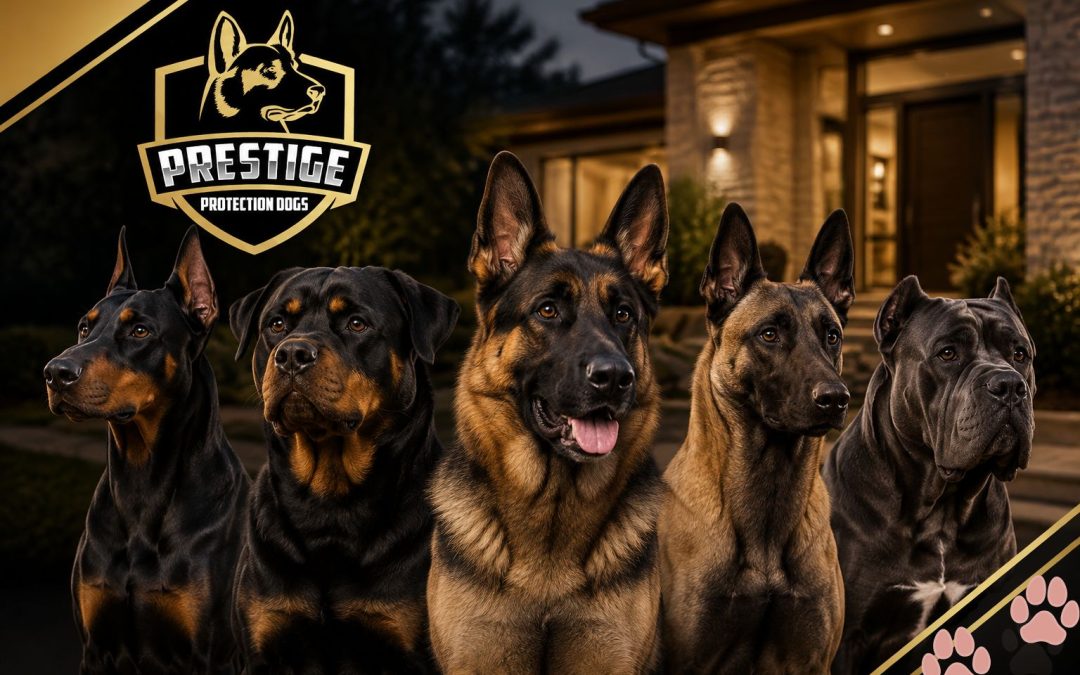
It’s something that many people wonder about when they are looking to buy a protection dog. Should I go with a male or female? Everyone will have their opinion on this, some will say males are tougher others will say females are smarter. It’s somewhere in between and I will explain why it’s an advantage to know the difference.
As you can see there are more things to consider when picking a protection dog than just the sex. However knowing the difference between the sexes can be beneficial. Dogs will vary in size, time of maturity, hormones, health and everyday management. So read on and learn about these 10 things to keep in mind when buying a male or female family protection dog.
I will be discussing mostly the german shepherd as he is one of the most popular dogs to use for personal protection.
Quick Summary: Male vs. Female at a Glance
| Consideration | Male | Female |
| Typical size (German Shepherd) | Larger and heavier, often about 65 to 90 lb | Slightly smaller, often about 50 to 70 lb |
| Physical deterrence | Stronger visual presence | Athletic and agile, less imposing |
| Maturity | Slower, often 2 to 3 years | Often faster, around 1.5 to 2 years |
| Hormonal management | Marking, roaming, same-sex tension | Heat cycles unless spayed |
| Trainability | Excellent when well bred | Excellent when well bred |
| Typical protectiveness | Territorial and bold | Alert, family-focused and discerning |
| Dog-to-dog compatibility | More tension with other males | More tension with other females |
These are general tendencies. Individual dogs vary a great deal, so treat this table as a starting point rather than a rule.
What Does “Protection Dog” Really Mean?
You should know what you’re looking for when comparing the two. You want a protected dog, not an aggressive dog. He should be able to live in your house with no problems. Act neutral towards guests and others that come to your house and when needed can protect you from any danger.
The core qualities are:
- Sound nerves: the dog stays confident around noise, crowds, unfamiliar places and surprises
- Discernment: it can tell ordinary activity from genuine danger
- Reliable obedience: it responds to commands even when excited or distracted
- Strong bond with the family: it is motivated to stay close and to work with you
- Low unprovoked reactivity: it does not lunge, snap or guard everything
Both males and females can have all of these qualities, and both can lack them. That is why temperament testing and responsible breeding matter more than sex alone.
1. Size, Strength and Visual Deterrence
Another factor is size. German shepherd males will generally be bigger and heavier than the female. If you have a really large male he can act as a great deterrent to intruders. Seeing/hearing a large dog can keep some criminals away from your home.
But don’t think the female is going to be tiny. Females are built for speed and agility and can be an amazing protector. If you want a dog that’s going to be bigger and you have more space around your property then you may want to go with the male. If you’re looking for a protection dog that will be easier to pick up, control on a leash or maneuver around your home then you may want to go with the female.
Practical note: Size also affects handling. A 90-pound dog that pulls or jumps can be hard on smaller adults, older owners or teenagers. Match the dog to the people who will actually handle it.
2. Temperament and Protective Style
Sweeping statements about gender and temperament should be treated carefully, but some patterns appear often among working-dog handlers:
- Males tend to be bolder, more territorial and more openly confident. They often “announce” themselves and can be more self-assured around unfamiliar situations.
- Females tend to be more attentive to their people, quicker to notice small changes in the environment and often more discerning about who they trust.
Many owners describe females as more intuitive and males as more imposing. These are tendencies, not guarantees. A well-bred, well-socialized male can be gentle with children and guests, and a well-bred female can be formidable when needed.
The key point: look at the individual dog’s temperament test and behavior, not just its sex.
3. Trainability and Focus
Both genders can be trained very easily. Females tend to grow up mentally earlier than males. Which can make them easier to train at a younger age. They can grow to be just as distracted once their male hormones take over around 8-14 months old.
A good male will train just as easily once they reach maturity. There isn’t much of a difference when it comes to sex. You will see more of a difference if your dog is well bred or poorly bred. Or if you train them consistently.
Whichever you choose, expect to invest in:
- Early socialization with people, surfaces, sounds and environments
- Foundational obedience such as sit, down, place, recall and heel
- Impulse control and calm behavior in the house
- Professional guidance for any protection-specific training
4. Maturity Timeline
Females often reach adult behavior sooner, commonly between 18 months and 2 years. Males commonly take until 2 to 3 years to fully settle. During the teenage phase, a male can seem clumsy, testy or distractible, which is normal but requires patience.
If you want a dog that will be reliably calm and mature relatively early, a female can have a slight edge. If you are prepared for a longer adolescence and the steady training that goes with it, a male can be equally rewarding.
5. Heat Cycles, Marking and Hormonal Behavior
Hormones create some of the biggest day-to-day differences.
Intact females go into heat roughly twice a year, with cycles lasting around three weeks. During this time you will deal with bleeding, attention from male dogs, and sometimes temporary mood or focus changes. This requires management, especially if you have other dogs or live in a busy neighborhood.
Intact males may mark territory, roam if they smell a female in heat, and show more tension with other male dogs. They can also be more distracted when hormones surge.
Spaying or neutering reduces many of these issues, but it is a decision to make with your veterinarian, not an automatic step (see the next consideration).
6. Spay and Neuter Timing and Health
It is an important subject that many people do not understand. There have been studies done on dogs (especially the German shepherd) at vet schools that show if you spay/neuter your dog too young it can have effects on their joints and may be more prone to certain orthopedic issues. Most vets will tell you to wait until your dog is fully grown before doing so. It can vary depending on if it’s male/female, what breed and size.
What to keep in mind:
- Ask your vet about the best timing for your specific dog rather than following a one-size-fits-all rule
- Females have additional health considerations, such as the risk of pyometra (a uterine infection) and mammary tumors, which are part of the spay conversation
- Males have different considerations, including certain prostate and testicular conditions
- Behavior changes after surgery vary; neutering does not fix poor training or fear-based behavior
Since this involves medical decisions, always rely on your veterinarian’s guidance for your individual dog.
7. Family and Child Compatibility
Both males and females can be wonderful with children when properly raised. Differences tend to be about management rather than safety:
- A larger male may accidentally knock over small children during play, so supervision and training are essential
- A female may seem more naturally attentive and gentle with young children, though this varies widely
- Neither sex should be left unsupervised with small children, regardless of breed or training
The more important factors are socialization, calm handling and teaching children how to respect the dog. A dog that feels safe and has predictable routines is far less likely to react poorly in a busy household.
8. Other Pets in the Home
When you already have a dog it becomes important to know what sex they are. Dogs of the same sex can be competitive with each other. It’s best to get the opposite sex if you already have one. Especially if you have 2 male dogs that aren’t fixed or 2 female dogs that aren’t fixed.
For cats and other small animals it really depends on how they were exposed at a young age. Also depends on their prey drive. You should always introduce your new dog slowly. Never assume because they are a protection dog they will take to other animals.
9. Cost, Availability and Training Investment
Depending on lineage, health tested, level of training etc. There is a big price range. Most programs will have similar pricing on males and females. Females may be harder to find due to the female being kept in the program to breed or just the demand of buyers asking for males.
When comparing costs, look beyond the purchase price:
- Veterinary care, including spay or neuter surgery if you choose it
- Quality food for a large, active breed
- Ongoing training and refresher sessions
- Fencing, equipment and, if needed, boarding
- Insurance or a health fund for orthopedic and emergency care
A less expensive guard dog in the world that needs extensive retraining can end up costing more than a properly trained one.
10. Your Lifestyle, Experience and Goals
The final consideration is the most important: you. Ask yourself honest questions.
- How experienced am I with large working breeds? First-time owners often do better with a dog that is easier to manage and more forgiving.
- Who will handle the dog daily? If a smaller adult or teenager will walk the dog, size matters.
- What is my main goal? Deterrence, family companionship, home security or all three?
- How much time can I commit? Exercise, training and mental stimulation are non-negotiable.
- What is my living situation? Apartment, suburban home, acreage and neighbors all affect your choice.
There is no universally “better” sex. There is only the best fit for your household.
Common Myths About Male vs. Female Protection Dogs
A few widespread beliefs deserve a reality check:
- “Males are always more aggressive.” Not true. Aggression is driven by genetics, fear, training and environment more than sex. A stable male is safer than an anxious female, and vice versa.
- “Females are always easier to train.” Many females mature faster, but plenty of males train beautifully. Consistency and quality of the dog matter more.
- “Females are weaker protectors.” Well-trained females are fully capable protectors and are widely used in police and military work.
- “Neutering or spaying makes a dog a better guard or a worse guard.” It does not automatically change protective ability; it mainly affects hormones, behavior around other dogs and some health risks.
How Prestige Protection Dogs Can Guide Your Decision
If your able to speak to others that handle protection dogs day in day out it becomes easier to choose a male or female. Prestige Protection Dogs offers trained German Shepherds. Dogs that have been chosen to have stability and are bred to be around family members. They want to make sure their dog is calm and have good decision making skills and will listen to commands. Which leads into what we have been mentioning in this article.
If you are comparing options, you can learn more about their trained personal protection dogs and how dogs are evaluated for temperament and household fit. Whatever you decide, speak with a qualified professional about your family, your experience and your goals before you commit.
Final Thoughts
When most people ask this question they don’t want to know which one is going to be more protective or smarter. They want to know which will better suit their needs. Most males are larger and more dominant in size. Females usually grow up quicker and can be more attentive. There are plenty of great protection dogs out there if you buy from a good line.
Research is key. Ask questions about the dogs you want and their testing. Consult with your veterinarian and see what will best suit your needs. If you choose a dog you will have a protection dog.
Frequently Asked Questions
1. Are male or female dogs better for personal protection?
Neither is universally better. Males offer more size and presence, while females often mature faster and can be very attentive. Temperament, training and fit matter more than sex.
2. Are female protection dogs less aggressive than males?
Not necessarily. Aggression depends on genetics, socialization and training. A well-bred, well-trained dog of either sex should be calm and controlled around family and guests.
3. Should I spay or neuter my protection dog?
It depends on the dog and your goals. Many veterinarians suggest waiting until physical maturity in large breeds, so discuss timing and health risks with your vet.
4. Which is better with kids, a male or a female?
Both can be excellent with children. A larger male may need extra supervision because of size, but socialization and training are more important than sex.
5. Can I keep two protection dogs together?
Often yes, but opposite-sex pairs usually have fewer conflicts than same-sex pairs. Introduce dogs slowly and seek professional help if tension appears.

Spencer Bowman is a well established business owner, breeder, obedience trainer, and protection dog trainer with over twelve years of professional experience. He is the founder and owner of Prestige Protection Dogs, where he specializes in developing elite working dogs and offering a personal protection dog for sale to qualified clients. Spencer is the first American to qualify for the French Ring selectives with a self bred and fully trained dog, Lycan, achieving an average score of 374 out of 400 across five trials. He has also successfully trained and supported multiple teams in Mondio Ring and French Ring disciplines.