Protection dog training is the fiercest and most dangerous sport a dog (and its trainer) can perform together. But it’s through this difficult training that these dogs become the loving, life-saving protectors they are to their owners and families.
Protection dogs are tested and proven in all the important areas of obedience, socialization, tracking ability, defensive maneuvers, and offensive (or attack) maneuvers. After being put through the fire of protection dog training, they emerge as a truly rare gem.
Some, even attain to the title of elite executive protection dogs.
They are:
- Fierce. But they’re controlled.
- Powerful. But they’re gentle.
- Fearless. But highly intelligent.
- Dangerous. But they bring safety.
So, how can protection dogs keep you safe? How are they trained? Can you train your dog for protection on your own? And what are some ways you can start training your own dog to protect you, right now?
We’ll be answering all that and more in this article. So, let’s dive in!Note: If you’re looking for a professional protection dog trainer—or a fully-trained protection dog delivered to your doorstep—Prestige Protection Dogs can help. With over 10+ years of experience in protection dog training and international acclaim, we’re your go-to family for world-class protection you can count on.
We’re located in Wilton, California. But don’t worry if you’re far away! We deliver protection dogs to your doorstep anywhere in the US. Plus, we spend 3–5 days with you and your family to make the transition a dream. Any of that sound good? Click below to contact us now!
Get My Dog
How Dogs Protect You

Seems pretty straightforward, right? But is it really? Not necessarily. At least, if your dog isn’t protection trained…
As you know, most dogs are naturally protective. They might bark. They might even bite. But unless they’re trained in protection work, neither you, the dog, or an attacker will really know what to expect—and that’s never a good thing.
You should know how your dog will act in a dangerous scenario when your safety or life could be at risk. And that’s a big benefit of having a dog with protection training.
Rather than just “hoping” your dog is going to do what’s necessary—you actually know your dog is going to do the right thing. In fact, the whole situation is 100% under your control. Sounds pretty nice, right?
And with protection dog training, your dog may be capable of performing intricate protective tasks, such as:
- Bite on command
- Switch to “guard mode” and defend
- Hold-and-bark
- Intruder capture
- Property protection
- Perimeter searches
- Carjacking and kidnapping protection…
- …and more.
Pretty amazing. But it takes intense protection dog training to master these heroic feats of controlled aggression, obedience, and intelligence. What do you think that training might look like?
What Is Protection Dog Training?

Protection dog training (also called Schutzhund, IPO, or IGP) is the intense and dangerous sport of training a dog to do protection work. The training enables these canines to release controlled aggression on command—or in a variety of specific scenarios.
Protection dogs may be utilized for a number of different tasks, such as:
- Property guard work (these are called guard dogs),
- Family protection work (called family protection dogs),
- And personal protection work (called personal protection dogs).
While all these dogs must be educated to perform their duties properly, the training family and personal protection dogs receive is the most difficult. And learning the complex commands takes significant time and effort.
Let’s talk about the training these herculean dogs undergo…
Personal Protection Dog Training

Protection Dog Training: Level 1 – Tracking

The first level of protection dog training is the “tracking phase,” during which the dog’s scenting ability will be carefully tested. With the dog well out of sight, a “helper” (sanctioned volunteer with protective gear) will walk the course. They’ll travel up to approximately 2 miles, zig-zagging and making turns.
While they move, they’ll drop up to eight, tiny pieces of cloth or other objects (called “articles”). And then, if that wasn’t enough, the dog must wait for the scent to “age” for up to three hours before entering the course.
When they finally get started, they’ll have about 45 minutes to complete it—flawlessly.
And that’s just the first level of training! Next up: obedience.
Protection Dog Training: Level 2 – Obedience

If the dog passes the first phase of the trial, he/she will be met with the obedience phase. In this phase, the dog must respond immediately to a list of commands.
For protection dogs, the obedience phase is more like a cross between obedience, agility, and focus. They’ll be tested in simple commands like “heel” and “out” commands. But they’ll also be performing commands such as jumping hurdles and the like.
And the real kicker? They’ll have to maintain focus on the commands of their handler, without being distracted, as guns are being fired around them! That’s more focus than most of us humans can muster.
Next up, is the most intense phase of the trial: the protection phase.
Protection Dog Training: Level 3 – Protection

The protection phase is the most difficult and dangerous portion of the trial. A sanctioned “helper” will dress in protective gear—wearing protective bite pants and a bite sleeve attached to their arm.
The judge will order that certain actions are taken to showcase the dog’s ability to control itself and remain “in control” of its handler. They will execute commands and respond to scenarios such as:
- “Hold-and-bark”
- Guarding techniques (against possible threats)
- Bite on command
- Release on command
- “Out” and “In” on commands
- Self-defense maneuvers
- Escape prevention (of the “escaping” helper)
- Search for hidden helper
- And more…

While this training might sound like a lot of fun, don’t doubt for a moment if it’s dangerous.
It is.
And many trainers and helpers have been injured while engaging in protection training. Which brings us to our next point… Can you train your dog to be a protection dog by yourself?
Can I Train My Dog To Be A Protection Dog?

You can probably train your dog to be a watchdog or even a guard dog without much danger involved. However, if you want to train your dog as a certified personal protection dog, you need to be aware of the risks and dangers.
- Protection dog training is extremely dangerous and you or a loved one could become injured.
- If you aren’t a professional, you could use bad training methods and cause your dog to become unsuitable to live with.
- It takes a significant amount of training and effort (many hours) to effectively train a protection dog.
- You’ll have to pass an intensive trial to prove your dog has what it takes to be a true protection dog.
Note: Sound like too much? Don’t worry! If you would like a professionally trained protection dog, we can deliver one straight to your doorstep anywhere in the US. And if you live near Prestige Protection Dogs, we can train your dog for you. Just reach out and contact us.
Dangers aside, here are a few ways you can train your dog to protect you (safely):
How To Train A Protection Dog

There are a few ways you’ll want your dog to respond when you’re potentially in danger. For instance, you’ll probably want your dog to bark when there’s danger outside—or to bark and growl in an intimidating fashion when a threat approaches you.
But how can you train your dog to act in those ways?
All training is an iterative, step-by-step process. You’ll need to give your dog the building blocks that act as a platform for each new level of learning. Kind of like you learned your ABCs before you started spelling class.
Here are a few steps you’ll want to take:
1. Teach Your Dog Obedience Commands

Unless your dog knows how to obey simple commands, it won’t be able to learn anything more complex. You’ll want to teach them simple skills, like:
- Come
- Heel
- Lay down
- Stay
- Retrieve
- And others…
You need to teach them to understand reward-based training (also called “positive reinforcement”), as well as “negative reinforcement” training.
2. Use Positive & Negative Reinforcement Training

It’s important to note that negative reinforcement training never—and we mean NEVER—means striking your dog. Being violent or abusive toward your dog will only create dangerous and aggressive tendencies; lack of trust, and fear.
To clarify: an example of properly employed negative reinforcement would be you, gently pressing down on your dog’s tail-end to get them to sit. The pressure of your hand on your dog’s back will be discomforting, causing them to sit down. But it doesn’t hurt your dog.
Afterward, it’s important to pair the negative reinforcement with the positive reinforcement of treats, praise, and cuddles. Training should always keep your dog stimulated and having fun. So, don’t overextend the length of your training sessions.
3. Give Your Dog Socialization Training
One of the most important parts of your dog’s training is socialization. Socialization is your dog’s ability to be around other dogs and humans without becoming unduly aggressive.

The best time to socialize your dog is in the earlier stages of its life (within the first 16 weeks). During this period, utilize walks and exploration to make your dog more comfortable with things that frighten it.
Ask others who are passing by with a dog if it’s okay for your puppy to sniff, and say, “Hi”. Getting acquainted with other dogs will help reduce aggression levels in the long run and make your dog more safe and suitable for protection.
4. Teach “Bark On Command”

If you want your dog to become a great watchdog or guard dog, you’ll need to teach him/her to bark on command. So, how do you do it?
One of the easiest ways to teach your dog to bark on command is with association and positive reinforcement. When your dog begins to bark naturally, say the word you would like associated with “bark”. For example: “Speak!” Make sure your dog hears you.
Reward your dog for barking. Say the word again, and if your dog barks, give a reward. Then, (since you’ve hopefully taught your dog to “sit” already) use your “sit” command to interrupt the bark. Then, use the bark command again—and if your dog barks—give a big reward!
It may take some time. So, just keep trying. You can also use this when your dog barks at a stranger. Say your “bark” command as they react to the stranger and reward them afterward.
5. Give Your Dog The Confidence To Defend You

Now that your dog knows the bark command, allow a friend to approach you. Give the bark command and have your dog bark at the friend. When your dog barks, have the friend run away “scared.” This should give your dog more confidence to defend you against real threats in the future.
If you’re wanting to move forward with the attack phase of training, we suggest you don’t do so without the help of a professional trainer. Attack dog training is extremely dangerous and shouldn’t be taken lightly.
Frightening Fact! Even professional trainers often get hurt during protection training. So, it’s best to leave it to them.
So, if you decide to seek out a professional trainer—how old should your dog be when they start training? Let’s get into that next…
What Age Should You Start Protection Dog Training?

Protection dog training is difficult for a dog of any age. It requires the most intelligent dog breeds, just to start. And since all dog breeds are more easily trained at a young age, it’s important to start the basic training of socialization and obedience right away (within the first few weeks).
During that period, they’ll learn the necessary building blocks they’ll need to begin protection training. Ideally, socialization and obedience should happen in the first 8 weeks. After that, protection work should begin.
How long can the protection phase wait? Protection dogs should be trained before about six months. Training in those first few months will be more effective and much safer.
Best Protection Dog Breeds To Train
Protection dog training requires dogs that have the highest levels of intelligence and trainability—as well as physical strength, agility, and speed. Each elite protection dog has its strengths and weaknesses.
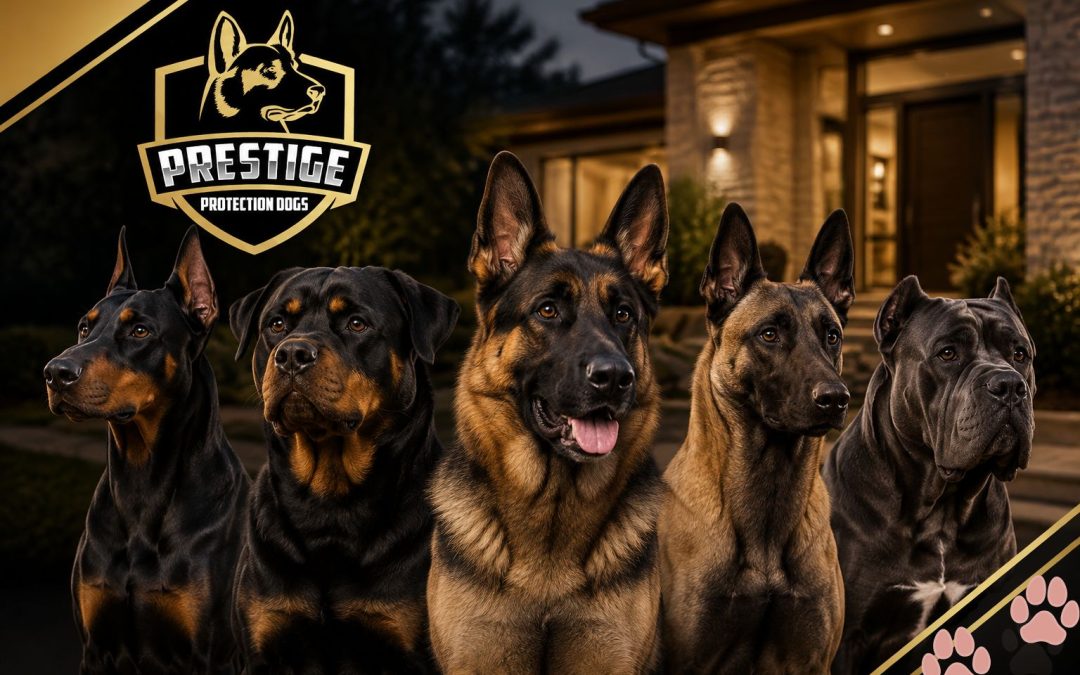
Here are a list of a few of the best protection dog breeds:
- Belgian Malinois security dogs
- German Shepherd security dogs
- Dutch Shepherd security dogs
- Doberman security dogs
- Rottweiler security dogs
- Cane Corso security dogs
- Giant Schnauzer security dogs
Protection Dog Training For Puppies

At Prestige Protection Dogs, we start our training while our dogs are young and teachable. We leverage their youth and curiosity to help them reach new heights in the protection dog world.
In fact, our dogs have performed on the international stage, winning at the French Ring (which is the most difficult in protection dog sports). And in the case of most dogs, training while they’re young is a big factor in how successful and speedy they are at learning their job.
Professional Protection Dog Training

Do you need your dog trained for protection work? With over 10 years of protection dog training excellence, Prestige Protection Dogs can train your canine to be all he or she can be.
We truly have a passion for dogs and take the utmost care of our pups. If you’re interested in having us train your puppy as a protection dog, please reach out to us.
Protection Dog Trainer Near Me

Wondering where you can get your puppy trained for protection work? If you’re living near Wilton, California—you’re located next to one of the world’s best protection dog trainers: Prestige Protection Dogs.
We’re located at 12729 Leo Ln, Wilton, CA 95693. Make sure to reach out to us for all your protection dog needs.
Not near us?
We may not be able to train your current dog. But we do offer fully-trained protection dogs delivered to your doorstep anywhere in the US. Our dogs are world-class, and we can even customize their skill sets for you.
- Just check out our available protection dogs for sale.
- Or contact us by clicking the button below:
Conclusion:
You’ve just learned a ton of stuff about protection dog training. Congratulations! You deserve a snack or something… 😉
You know how protection dogs can protect you. And you know how they’re trained to do it—as well as some of the dangers of protection work. Don’t forget to reach out to us if you have any questions about our services.
We hope you’ve enjoyed this article. If you did, make sure to follow us on Social Media:
- Here: Connect With Us On Facebook!
- Here: Follow On Instagram!
- And here: Check out our YouTube!
Protection dogs must pass a difficult trial before becoming certified. In order to pass the test, a canine must go through the standard qualifications during a single attempt before a judge.
The trial has three phases, and they will only have one chance to make it through the entire course. If they are deemed “out of control” or if they err during the trial—they will be disqualified and must return at a later date to try again.
The three levels of personal protection dog training are these:
About Prestige Protection Dogs
We strive to deliver the highest quality personal protection dogs for sale in the industry. With our protection dog trainers’ knowledge of breeds, obedience training, and protection training, we can provide you with a dog that will make you feel safe and secure in any circumstance.
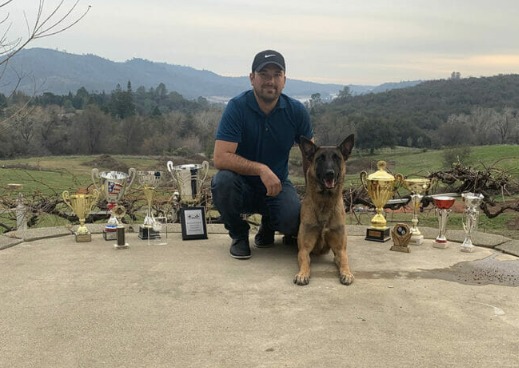
Spencer Bowman is a well established business owner, breeder, obedience trainer, and protection dog trainer with over twelve years of professional experience. He is the founder and owner of Prestige Protection Dogs, where he specializes in developing elite working dogs and offering a personal protection dog for sale to qualified clients. Spencer is the first American to qualify for the French Ring selectives with a self bred and fully trained dog, Lycan, achieving an average score of 374 out of 400 across five trials. He has also successfully trained and supported multiple teams in Mondio Ring and French Ring disciplines.