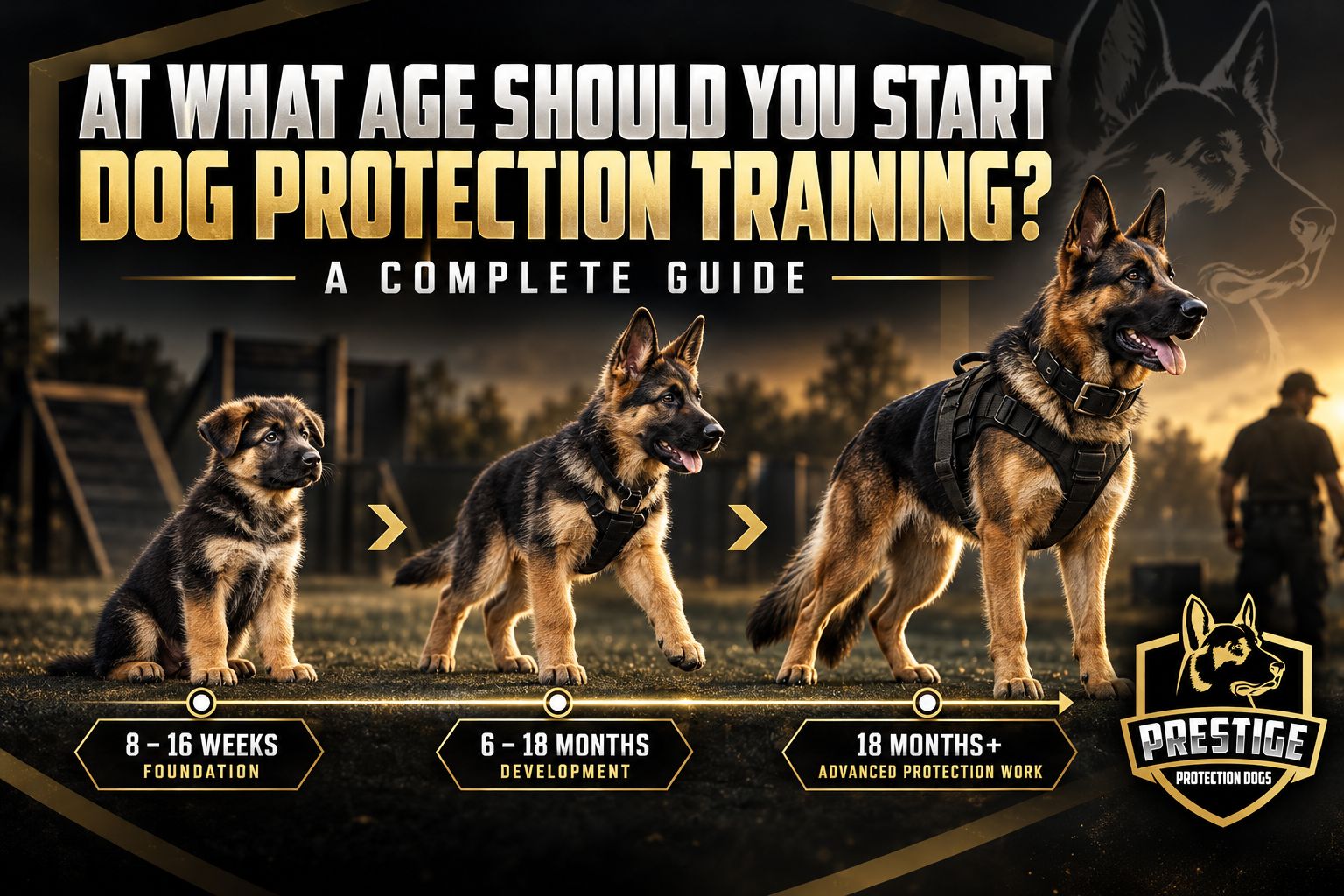
Real protection training often starts between 18 months and 3 years of age. Foundational work, however, starts at 8 weeks.
What is the most appropriate age to start training a dog for protection? A question I constantly come across, especially when asked by those looking for personal protection dogs for sale. Many people wonder why a puppy cannot start bite work immediately, and the honest answer is that the biological clock needs to be respected. Age and maturity decide how a protection dog turns out.
When a young dog is rushed into serious work, you end up with an unreliable, anxious adult. Wait past the ideal window, and you lose the natural drive that made the dog promising in the first place. Below is the exact framework I use with every dog I train for protection tasks.
Foundation Training – 8 and 16 Weeks
It doesn’t matter how promising the litter looks; the time period to set their foundation is 8 and 16 weeks. The American Kennel Club documents a critical socialization window that runs from roughly 3 to 12-14 weeks of age, when a puppy’s brain absorbs new experiences at a remarkable rate. During this stretch, we deliberately expose puppies to unfamiliar sounds, surfaces, and people in controlled environments.
We introduce basic obedience commands like sit, stay, and come. Most importantly, we build the handler bond that every future protection dog depends on. Pushing formal bite work during this window risks producing a fearful, reactive adult instead of a confident one.
What Happens Between 6 and 18 Months
This is the stage where prey drive gets shaped into something usable. The pup is no longer a baby, but he is far from mature. In my experience, formal bite-work groundwork can begin around 10 months, provided the earlier developmental stages were handled correctly. We introduce controlled targeting, light bite-sleeve exercises, and low-pressure scenario games during this window.
Anyone comparing family protection dogs for sale should ask exactly how a breeder handled this stage, since a dog pushed too hard too early here tends to shut down instead of building confidence.
The Real Sweet Spot – 18 Months to 3 Years
This is when a dog finally becomes ready for serious, reliable protection work. More than a decade of experience in training and placing protection dogs shows that 18 months to 3 years is the ideal window. It is the period when emotional stability and impulse control finally catch up to physical ability.
Growth stages close by this point, and the brain has matured considerably compared to the adolescent stage. The dog can process genuine stress and not act purely on instincts.
| Age Range | Stage Training | We Focus On |
| 8- 16 weeks | Foundation | Socialization, basic obedience, bonding |
| 6-18 months | Development | Prey drive, light bite work, targeting |
| 18 months – 3 years | Placement- ready | Advanced bite work, real scenarios, control under pressure |
Common Mistakes People Make with Timing
Regardless of breed or budget, I see two most common mistakes on repeat.
- The first is impatience: buying a puppy and expecting bite work within weeks because a seller promised quick results.
- The second is the opposite extreme: waiting until a dog is four or five years old, hoping maturity alone will substitute for structured training. Neither approach produces a dependable protector.
A dog’s genetics matter too; we only work with lines that have a documented history of stable temperament under pressure. No amount of correctly timed training can fix an unstable foundation. German Shepherds and Belgian Malinois dominate this industry precisely because their working lines were bred with this timeline in mind.
How Do We Know a Dog Is Actually Ready?
I look for the same signs every time, no matter the breed:
- Alertness: The dog notices changes in its surroundings without panicking.
- Retrieval: Loud noise startles the dog, but it moves on.
- Focus: The dog can follow through a command even with distractions.
- Controlled drive: He wants to engage, but he waits for the command.
- Bond with the handler: He checks in with you instead of freelancing.
If a dog is missing two or more of these at 18 months, I push back the timeline. We use age as a guideline.
Do Health Checks Matter as Much as Age?
Age is not the only readiness factor I check before advancing a dog through the program. Every dog undergoes a full veterinarian clearance, including hip and elbow evaluations, before we increase the training intensity. A physically unstable dog can appear emotionally ready at 18 months but with a high risk of injuries under the demands of real protection work.
We also track weight, joint development, and overall conditioning throughout adolescence, since strength and stamina need to build alongside temperament. Age tells you when a dog’s mind is ready. Health screening tells you whether the body can back it up.
Why Choose Prestige Protection Dogs?
I have bred and trained working dogs for over a decade, and I still follow this age-based approach with every single dog we place. We at Prestige Protection Dogs do not rush a puppy into bite work to speed up a sale, and we do not hand over an untrained adult either. This is exactly why I built our Dog Training Programs for Family Safety around each dog’s actual maturity level. Every dog you see among our available protection dogs has already passed through each stage on its own timeline, tested and proven at every step.
As a championship trainer, Spencer Bowman has trained and bred high-performance dogs. German Shepherds, Belgian Malinois, Cane Corsos, Rottweiler- we place them all as personal, family, or executive protection dogs. Our trainers hand-deliver fully trained protection dogs along with transition training for the handlers and family members.
Does Breed Affect the Best Age to Start Protection Training?
Yes, breed and bloodline can influence how quickly a dog develops physically and mentally.
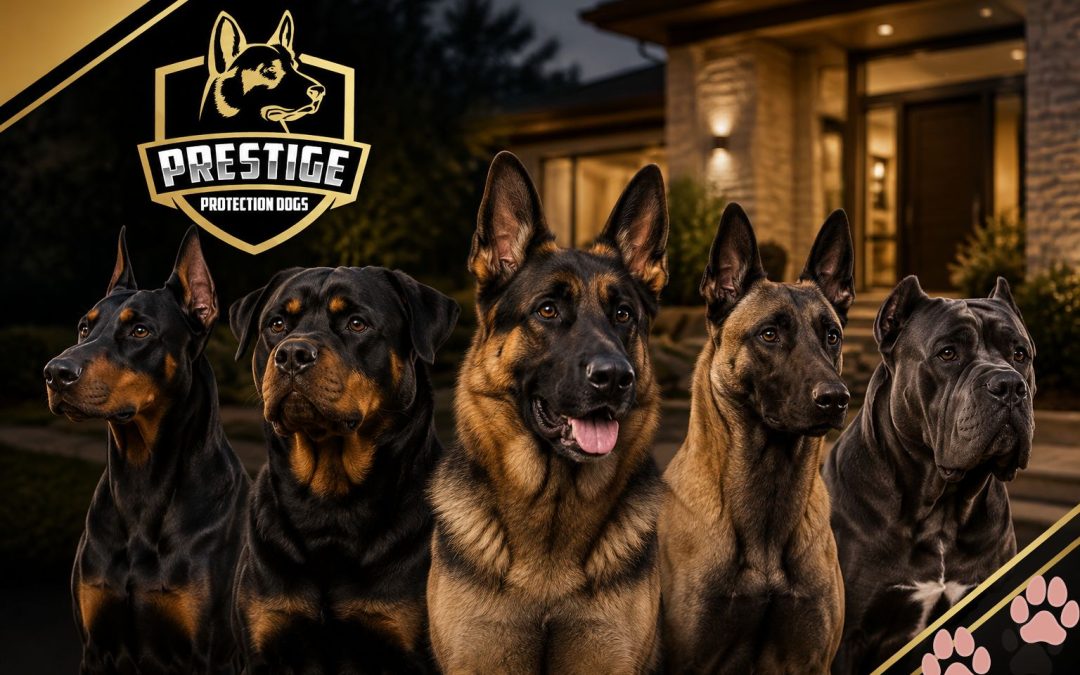
German Shepherds, Belgian Malinois, Rottweilers, Cane Corsos, and other working breeds do not all mature at exactly the same pace. Even within the same breed, one dog may show strong confidence and control earlier than another.
Working-line dogs are often selected for traits such as:
- Confidence
- Trainability
- Environmental stability
- Working drive
- Recovery from stress
- Physical endurance
- Strong engagement with the handler
That does not mean every dog from a working breed is automatically suitable for protection work.
A Belgian Malinois may mature differently from a Cane Corso, and two German Shepherds from different bloodlines can show very different levels of drive and stability at the same age.
The best training timeline should be based on the individual dog rather than the breed name alone.
Conclusion
Age is not just a number in protection training. It indicates whether a dog builds real drive or only knows how to react. Start socialization at 8 weeks, build drive through adolescence, and save serious protection work for 18 months and older. Ask any trainer where your dog’s age fits into this timeline before you commit to a program. As a potential dog owner, it is important to understand the timeline and your protection dog’s standing.
Frequently Asked Questions
Can a puppy start protection training at 8 weeks?
A puppy can begin foundation work at 8 weeks, including socialization, bonding, obedience, confidence-building, and environmental exposure. Advanced protection work should wait until the dog is physically and mentally ready.
Is one year old too young for protection training?
Not necessarily. Some dogs may begin age-appropriate protection foundations during adolescence, but the training should match the individual dog’s development.
Is two years old a good age for protection training?
For many dogs, two years old can be an appropriate age for more advanced work because physical and emotional maturity are easier to evaluate. Readiness should still be assessed individually.
Can a four-year-old dog become a protection dog?
Possibly. A healthy four-year-old dog with strong temperament, obedience, confidence, and suitable genetics may still have potential.
What breed is best for protection training?
German Shepherds, Belgian Malinois, Rottweilers, Dobermans, Cane Corsos, and other working breeds are often used, but breed alone does not determine suitability. Temperament and training quality matter more.
How long does protection dog training take?
There is no fixed timeline. Training may take months or longer depending on the dog’s age, previous experience, temperament, goals, and how advanced the required work is.
Can any dog be trained for personal protection?
No. Not every dog has the temperament, physical ability, confidence, or working drive needed for reliable protection work. A professional evaluation is important before beginning.
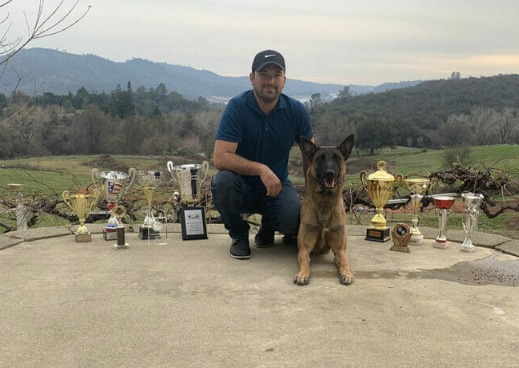
Spencer Bowman is a well established business owner, breeder, obedience trainer, and protection dog trainer with over twelve years of professional experience. He is the founder and owner of Prestige Protection Dogs, where he specializes in developing elite working dogs and offering a personal protection dog for sale to qualified clients. Spencer is the first American to qualify for the French Ring selectives with a self bred and fully trained dog, Lycan, achieving an average score of 374 out of 400 across five trials. He has also successfully trained and supported multiple teams in Mondio Ring and French Ring disciplines.